3.1 Lifelong Learning
3.1.1 Empower others in the school community to become lifelong learners
Blind Date a Book
This activity was part of a whole staff meeting held in the Learning Centre where I held a presentation on all the ways in which the Learning Centre staff could assist teachers in delivering the curriculum. At this meeting we provided nibblies and wine which went over very well on a Tuesday afternoon. As teachers arrived at the meeting they were intrigued as they walked past a table with 50 books wrapped in plain brown paper with the barcode written on the cover in black marker. These books had been carefully selected from the new Teacher Reference books, with a few senior NF and F thrown in as well. As teachers left the meeting they were encouraged to select their 'date' for the evening, who was to be taken home and unwrapped carefully. Barcodes were recorded next to staff names. One book had a $30 book voucher hidden inside for the lucky winner to add further enthusiasm for the activity. The activity stimulated a lot of discussion and joking, along with a greater awareness of the wealth of resources in the Learning Centre.
OZTL & Twitter
Whilst I subscribe to several list-servs and use several social networking sites, the two richest sources of information for me are OZTL list serv and my Twitter Professional Learning Network. Whilst I role model life long learning to students and colleagues, I also disseminate the cream of the innovative websites, tools and articles to students and colleagues. I hope to pique their interest or imagination, or to encourage thinking about new knowledge. The Twitter network consists of many ICT savvy people who either work at the Learning Innovation Centre, or for Smart Classrooms or who are at the cutting edge of education and technology nationally and internationally. I also follow bloggers and columnists from all around the world who have intelligent and thought provoking ideas.
3.1.2 Undertake research which informs evidence-based innovation in school library programs
With the exponential growth of social networking, students at our school were felt to be lacking the skills required to protect their privacy online and to avoid cyberbullying. To gather information regarding social networking and cyberbullying I put together a survey for students in Years 5 - 12. The results of this survey showed that cyberbullying was somewhat of a problem, and that very high percentages of students were using Facebook - from 38% in Year 5 to 95% in Year 11. Navigating Facebook privacy settings has been problematic for me as an adult, and a quick check of Year 7 & 8 Facebook profiles revealed about half were not set to private. To educate students about the concept of leaving a 'Digital Footprint', protecting their reputations online and ensuring their pages were private I conducted a series of lessons. I used the Youtube clip Digital Footprint - your new first impression as a discussion starter. I also used 'Protecting Reputations online in Plain English' by the Commoncraft Show. Finally - I signed my dog, Connie, up to Facebook as an example page to teach students how to change their settings to private. Along the way we all learned a lot - we found a further set of adjustments could be made to ensure all your information is private, as well as how to turn off other people tagging you in photos or checking you in to places without your permission. Prior to each lesson I checked profiles to find two students with private pages and two whose pages were public (but G rated). It was quite a shock for those students to discover that any creepy stranger or future boss could be perusing their page at their leisure. After this activity I turned off the data projector and had students check their page privately using Connie's profile. Meanwhile, the rest of the class used their laptops to check Google Images etc to see whether they had left a digital footprint.
3.1.3 Engage in debate on educational issues within the school community
Learning Team Facilitator
I was one of the seven teachers approached to be a Learning Team Facilitator early in 2011. The Learning Teams comprised a mix of eight primary and secondary teachers who met regularly throughout the year. The topics covered in the sessions this year were:
I found these sessions to be an excellent way to build stronger connections with my colleagues and I was able to suggest resources, strategies and ideas particularly in the area of ICT. An early 'reading' we were given involved Bloom's Taxonomy and practical ways in which we could cater for each level in our teaching. I emailed the Head of Teaching and Learning a link to the Bloom's Taxonomy for the Digital Age and he forwarded this to all staff. This opened up several discussions on the kinds of Web 2.0 tools that can be utilised to provide rich learning activities for students. I was also able to provide staff with a link to a Differentiation Placemat that neatly summed up all the key points of differentiation teachers had been exploring. This link came through OZ_TL, an invaluable discussion list-serv that I visit frequently to stay abreast of current trends in the world of teaching and libraries.
Recently I received a thank you letter from the Head of Teaching and Learning who has asked me to continue in the role next year with a different group of teachers.
3.1.4. Create and foster libary-related professional development opportunities for staff
This is carried out either in whole staff meeting such as the one described above (Blind Date Activity) or in smaller group settings. I am considered as part of the Humanities Faculty and the English Faculty and attend their meetings regularly along with occasional visits to the Primary or other faculty meetings. I am able to demonstrate websites such as Trove (National Library of Australia), Scootle (digital resources respository), The Commoncraft Show and their 'In Plain English' videos and other skills such as how to set Facebook settings to private. The commencement of the Learning Teams initiative has increased the opportunity to share my library-related skills and knowledge in an environment where teachers can ask questions and have skills demonstrated in a supportive environment.
3.2 Commitment
3.2.1 Are dedicated to excellence in professional service
3.2.2 Emphasise a learning and teaching focus in school library programs and services
3.2.3 Promote the profession of teacher librarianship in their schools and wider community
3.2.4 Foster a reading culture through the active promotion of literature
Children's Book Week
This is a very important week for our school and months of planning and organising ensure the week is a fantastic highlight of the year. The events of the week stimulate a positive atmosphere around reading and the entire school is involved in the fun. Activities include:
- Book Week Pantomime/show - written and directed by the Learning Centre Director and involving the Heads and Deputy Heads of Secondary and Primary and all of the Learning Centre staff. Costumes are elaborate and entertainment is the aim. 2010 - The Three Billy Goats Gruff. 2011 - Leigh Hobbs characters fly in for a visit.
- Book Week Dress Up day - whole school involvement. After the pantomime the children from each class come up onto the stage to display their costumes. Each primary Year level has a theme. Secondary students can follow their house theme or come as any character they prefer. There is a winning trophy for the best year level in the primary and the most enthusiastic secondary house. Photos included in photo gallery page.
- Author workshops each day - every class attends one workshop. 2010 - Mark Svendsen & Deborah Carlyon. 2011 - Nette Hilton and Richard Yaxley. 2012 - Brian Falkner and an illustrator (not yet confirmed)
- You be the Judge competition - described in detail below
- Year 8 in-house Readers' Cup
- Year 6 in-house Readers' Cup - described in detail below.
- Decoration of the Learning Centre with displays and huge paintings
 | 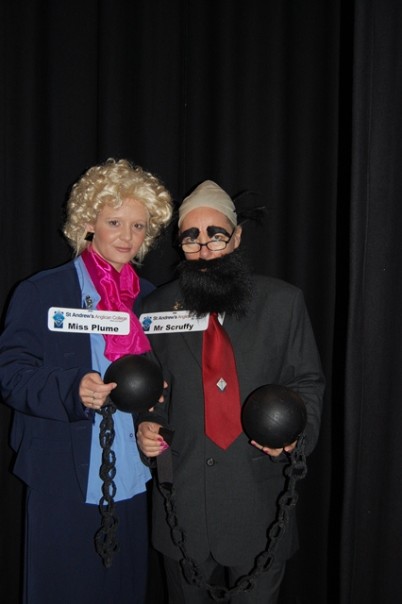 |
2010 - Billy Goats Gruff. I'm the goat in black. Mrs Troll - Learning Centre Director. Mr Troll - Head of Primary. | 2011 - Leigh Hobbs characters. I'm Mr Scruffy who Horrible Harriet keeps locked in the basement to do her homework. |
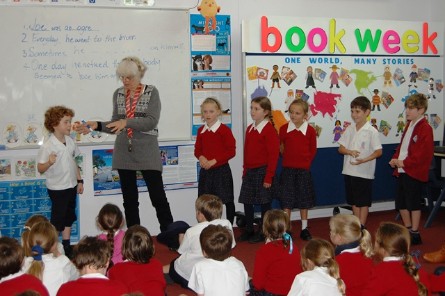 | 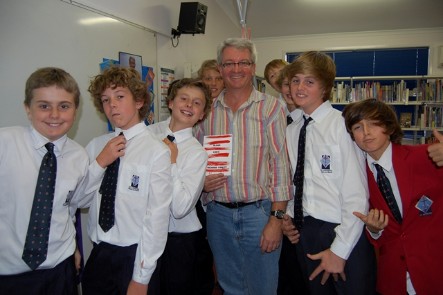 |
Nette Hilton with Year 3 children. Richard Yaxley with Year 8 boys.
Book Week Activity - You be the Judge!
I conducted this activity with Years 7, 8 & 9 in 2010 and Years 7 & 8 in 2011. For an added incentive there was a book voucher prize for the student in each year level who guessed the most correct winners. In some cases there was a tie so the names were drawn from a hat. The instructions are as follows:
For each category of books:
1. Look at the title and cover – how appealing is it?
2. Read the blurb on the back – does it hook you in?
3. Read the first few sentences or paragraphs – does the style appeal to you?
4. If it’s a picture book or non-fiction – flip through and look at the layout and images.
5. Think about your gut reaction – which one is the best in the category?
Consider the following:
« Early childhood books MUST appeal to and be suitable for 2 – 6 year olds
« Picture books – the illustrations must enhance the story
« Younger readers – these are for Primary age children
« Older Readers – must appeal to secondary students
« Non-Fiction – must inform the reader in an attention-grabbing and engaging way. The topic should be interesting as well.
The scoring sheet is found here. This activity has been very well received as the students enjoy seeing the shortlisted books for Older Readers & Picture Books but can also enjoy the Early Childhood books in a positive and supportive environment.
Speed Dating Books Activity
For this activity I select about 6 - 8 books that fall loosely into six genre. I have used fantasy adventure, historical fiction, biographies and autobiographies, picture books for older readers, adventure, humour, romance/relationships and 'something different' to include graphic novels and books in unusual formats or with unorthodox content. Each group is given one set of books to start with and records books they would like to borrow in the back of their diary or straight onto a reservation sheet. To peruse the books they look at the title and cover, read the blurb and perhaps the first paragraph to guage the style or see if it hooks their interest. They look at as many titles as they can in about 5 minutes when a small bell rings, books are stacked up and passed clockwise to the next group. This continues until the books arrive back at the table they visited first. Students can then select one to borrow from the stack in front of them. Once this has been done, each group can stand and walk to a book from another group they might like to borrow. If two students are after the same book they hold a 'rock off' to establish who can take the book and who has to go on the reservation list. I have used this activity with Years 6, 7, 8, 9 and 12. I would like to include the Years 10 and 11 next year, especially if I can time the session just prior to a holiday.
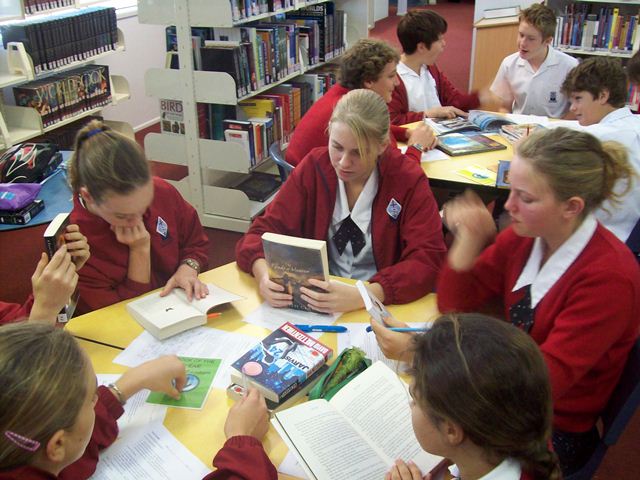 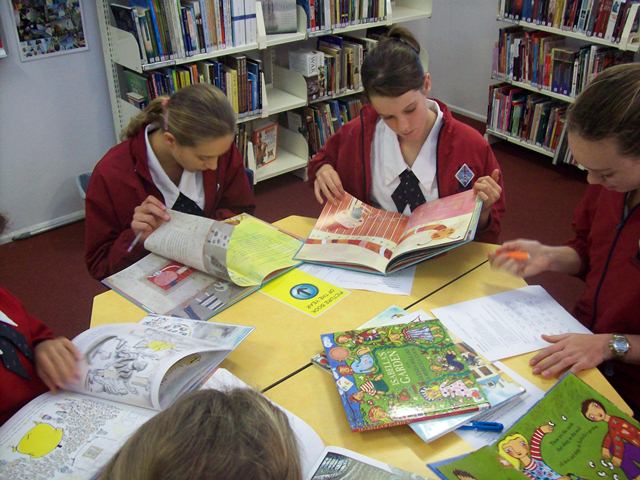 | 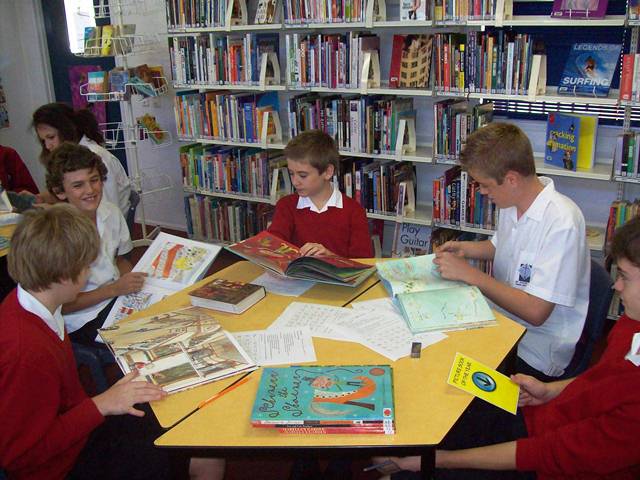 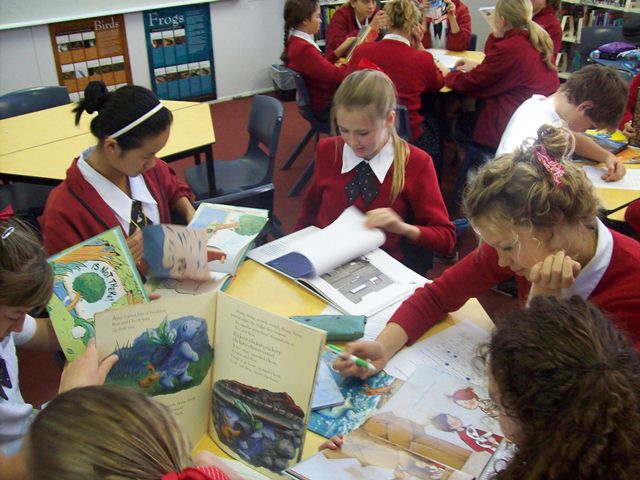 |
Year 8 students taking part in You Be the Judge. The Speed Dating Books activity is run along similar lines.
3.2.5 Participate in continuing professional development
Elsewhere in this portfolio I have noted external professional development I have attended over the years. Our College conducts a considerable amount of Professional Development in-house, some of which is compulsory and some optional. As a result of this and attendance at external PD I have had no trouble meeting the minimum 30 hours of PD the Queensland College of Teachers require of teachers each year to maintain their registration. This year I have also accessed online webinars showing the latest that ANZRC database and Worldbook Online have to offer. More of these webinars seem to be available as the Elluminate tool becomes more widespread.
3.3 Leadership
3.3.1 actively engage in school leadership and participate in key committees
This year I have been a Learning Team facilitator (detailed elsewhere in this portfolio) and I attend English and Humanities Faculty meetings. I'm also on the ICT committee that discusses and implements initiatives and policies frequently.
3.3.2 promote and nurture 'whole school focus' on information literacy policy and implementation
The use of the ILPO system ensures we maintain a whole school focus to information literacy.
3.3.3 build and foster collaborative teams within school and professional communities
I attend regional secondary librarian network meetings each term, hosting SUNNET at our school in November 2011. I also attend SLAQ regional meetings and state meetings as well in my capacity as Sunshine Coast Councillor. Our Regional Readers' Cup network meetings are an invaluable way to continue networking with other teacher librarians as well as stay current with the latest high quality children's and young adult literature.
3.3.4 provide effective and transformational leadership to school library and information services staff
I currently supervise and mentor the two part time library and teacher aides, as well as our Year 11 trainee student who is completing a Certificate IV in Library Aide. Library staff and the trainee feel comfortable approaching me and seek my advice and guidance frequently. I also supervise and encourage our young library monitors as they carry out their duties.
3.4 Community Responsibilities
3.4.1 - Model the sharing of knowledge SPP Portfolio Part 1
3.4.2 - Actively participate as members of Professional Communities SPP Portfolio Part 1
Since writing my SPP Portfolio Part 1 I was appointed as the Sunshine Coast Councillor for SLAQ. I have attended the face to face meetings and telephone conferences. In recent weeks I participated in an online forum. I was also asked to contribute an article to the SLAQ newsletter on the merits of earning a Digital Pedagogy Licence (Smart Classrooms Ed Qld initiative).
3.4.3 - Demonstrate collegiality and mentor colleagues SPP Portfolio Part 1
3.4.4 - Promote library and information services to the school and the wider community SPP Portfolio Part 1
